
Brachiosaurus:

- This animal did not have to live in the water. In the movie, they discuss this animal being a swamp dweller. It was believed for a long time that these animals would not have been able to support themselves outside of wading through the coastal oceans or living in swamps. This is not true. There are several track sites of large sauropod dinosaurs that can be found across the globe. Many of the track sites show prints of animals that were even larger than Brachiosaurus.
- Brachiosaurus would not have been able to rear up on its hind legs. Many other sauropods could have done this with ease, but these animals have a similar build to giraffes- they have longer front legs then the do hind legs.
- Brachiosaurus would not have "chewed like a cow". These animals had peg like teeth which would have only allowed them to bite down on a branch and scrape the leaves off of the branch into its mouth.
Parasaurolophus:

- I think these may have been the only dinosaurs that Jurassic Park properly portrayed. Why? Because the only thing they are shown doing is moving in a heard. This is a documented behavior in Parasaurolophus (and all other hadrosaurs).
Dilophosaurus:
 | ||
| Pictured: The bane of my existence # 1 |
- Let's talk about this neckfrill. This did not happen. There would be muscle scarring on the vertebrae located within the neck showing that this animal had this flap of skin. So many kids ask me about this every time I am at the museum.
- Also, this dinosaur would not have been poisonous. There is the possibility that this animal (and all theropods) had a toxic bite because of the rotting meat left in their teeth after feeding. Think of a komodo dragon, not a spitting cobra.
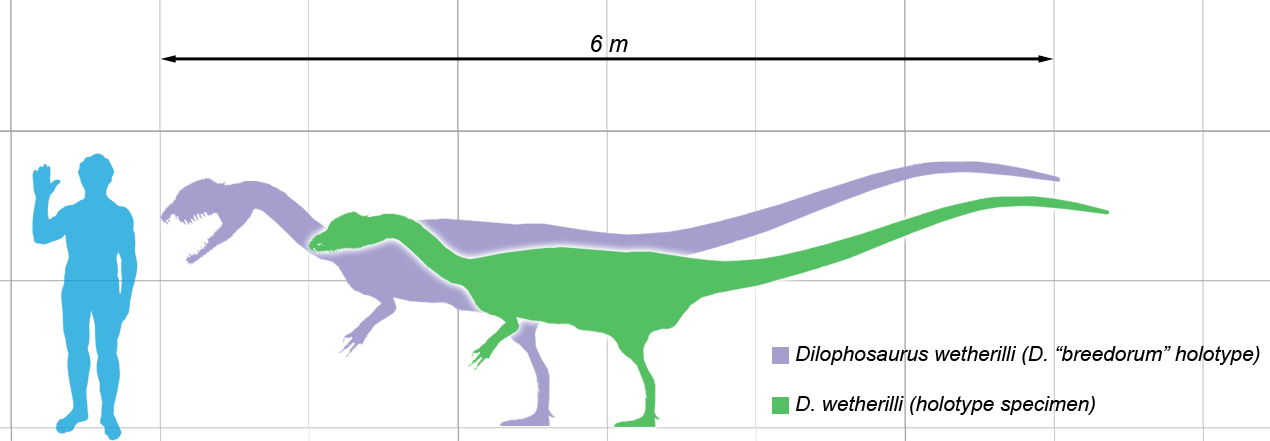
- Let's also talk about how little this guy was. Fun fact: they were NEVER this small. Here's a photo of a better depiction of the size of Dilophosaurus.
Velociraptor:
 |
| Pictured: Bane of my existence #2 |
- Velociraptors are my favorite non avian dinosaur. I even have one tattooed on me. However, I have a serious problem with the way that these animals were depicted.
- Velociraptor was feathered. There is no disputing this. There have been multiple fossils found that show marks in the bone where feathers would have gone.
- Their tails would not have wagged when they ran either. Theropods had very ridged fibers reinforcing the vertebrae in the spine to help counter-balance the weight of the animal. So, forget the Hollywood tail wagging- that's a byproduct of their special effects and full body suits.
- Two, they were not this big! Think of a velociraptor as an angry turkey with teeth and claws. The animals that they were depicting in the movie were most likely modeled after deinonychus (a much larger relative of velociraptor) or herrerasaurus (a theropod that lived in the middle Triassic in Argentina).
 |
| Remember: Angry turkey! |
Triceratops:

- The only problem I have with this that its horns look fossilized, but the animal is still alive. What was up with that? Also, how is its poo pile so big? I don't understand!
Tyrannosaurus Rex:

- People have some ideas about how Tyrannosaurus's vision would have worked, the idea that this animal's vision is based on movement is controversial.
- If a real animal that stood 30 ft high, and weighed in the area of 9 tons ran like that, the creature would dislocate it's own knees with each step of a run. There's a LOT of force in a 9 ton animal's leg.(the reason they did it that way--The animation tool that ILM was using for animating in a computer environment, Softimage, had no way to simulate ball-and-socket-type joints, such as the hip, so the animators faked one out of a hinge-type joint as a poor substitute).
- R. McNeill Alexander has argued previously that T. rex's leg bones were neither thick enough or strong enough to support a full grown animal running faster than 18 mph. Recently, James Farlow has argued that running at high speed (such as would be required to chase a jeep) would put T. rex at great risk of mortal injury if it fell. This arguement is based on the physics of falling at 45 mph -- the head dropping 11 feet to the ground and decelerating on impact with a force of 16 g.
- The T. rex always sounded like it was running on pile drivers. Any potential prey within miles would have beaten a hasty retreat at the sound of those booming footfalls. Also, tyrannosaurs had springy, flexible ankles, which would have made it very difficult, if not indeed impossible, for a T. rex to make that much noise, even if it wanted to.

No comments:
Post a Comment